A website can rank on Google and still remain absent when customers ask AI systems for recommendations. This guide explains the visibility qualification gap and shows how technical SEO, clear expertise, credible evidence, and conversion design work together.
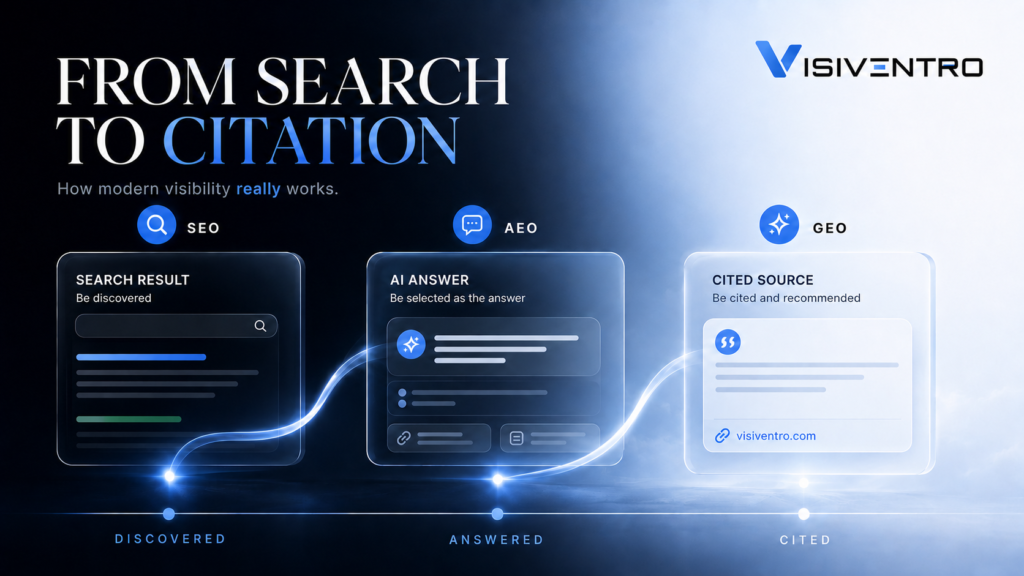
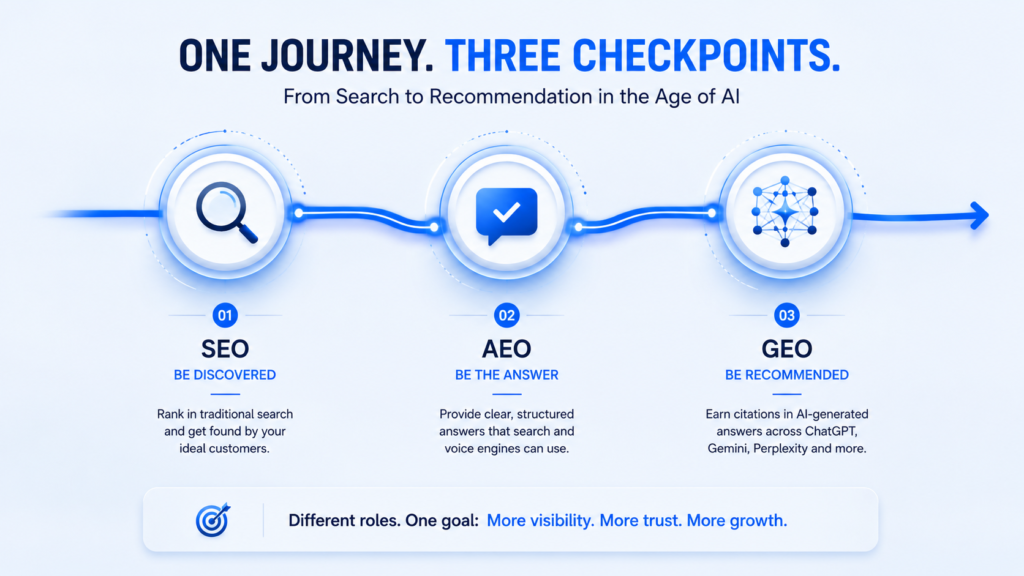
SEO, AEO, and GEO are not three competing strategies. SEO, or search engine optimization, makes a business discoverable in search results. AEO, or answer engine optimization, makes its information easy for answer systems to extract and present as a direct response. GEO, or generative engine optimization, increases the probability that AI systems such as ChatGPT, Gemini, Perplexity, and Claude understand the business well enough to cite it when they generate answers.
They are three checkpoints on one journey, built on one shared asset: a crawlable, credible, genuinely useful website.
Here is why this matters right now. A website can rank on Google, receive impressions, and look healthy in a conventional SEO report, yet remain completely absent when a buyer asks an AI assistant to recommend a provider or compare options.
That is not a contradiction. It is a new kind of visibility gap.
A ranking proves a page can be crawled, indexed, and matched to a query. A citation requires something harder: enough clarity, evidence, and consistency that a system is confident using your information as part of its answer.
Ranking is eligibility. Citation is qualification. This article explains what each discipline actually contributes, what the research and the platforms themselves say, and the practical sequence a business should follow, without the hype that surrounds this topic.
What SEO does
Search engine optimization improves the conditions that let search engines discover, understand, and rank a website: technical access and indexation, site architecture and internal linking, content matched to real search intent, page experience, and the authority signals that come from credible links and mentions. It is fashionable to declare SEO finished. The platforms disagree.
Google is explicit that its generative features, including AI Overviews and AI Mode, are rooted in its core search index and ranking systems and that pages must remain indexable and eligible for search to appear in them. Its official guidance on AI features also puts a persistent myth to rest: no special AI schema, no llms.txt file, and no new category of markup are required.
Established SEO guidance still applies to generative AI experiences in Search. Pages need to be indexed and eligible to appear, and no special schema or machine-readable AI file is required for AI Overviews or AI Mode.
So SEO has not been replaced. It has been given a second job. The first is still winning clicks from ranked results, which remains the largest source of qualified traffic for most service businesses. The second is supplying the raw material that answer engines and generative engines feed on.
An AI system cannot extract an answer from a page it never crawled, and it cannot cite a business whose content is too thin to establish what that business actually does. Weak SEO now costs a business twice.
What AEO does
Answer engine optimization is the discipline of structuring content so systems built to answer, rather than to list, can select your content as the answer. Those surfaces include featured snippets, People Also Ask boxes, voice responses, and, most consequentially, AI Overviews synthesized at the top of results pages.
Rand Fishkin of SparkToro has documented the rise of zero-click searches for years, and the conclusion is now mainstream: on a growing share of queries, the answer box is the battlefield, not the blue links below it.
Winning there requires an editorial discipline more than a technical one. Answer engines favor pages that resolve a specific question directly, early, and in extractable form. In practice that means opening with the answer instead of building toward it, writing headings that mirror the questions customers actually ask, defining terms in plain language, and keeping every claim specific and supportable.
The simplest diagnostic is the ten-second test. Open your most important service page and try to find a direct, quotable answer to the question a customer would ask. If you cannot find it in ten seconds, neither can an answer engine. Most service websites fail this test not because information is missing but because it is arranged for reading rather than for retrieval.
What GEO does
Generative engine optimization is the newest discipline and the one with the most genuine research behind it. The term was formalized in a study presented at the ACM SIGKDD conference in 2024 by researchers from Princeton University, IIT Delhi, Georgia Tech, and the Allen Institute for AI.
The team built a benchmark of ten thousand real queries and tested how content changes affected visibility inside AI-generated answers. The methods that worked best were not exotic. Adding relevant statistics, citing credible sources, and including quotable, well-attributed statements consistently outperformed keyword-focused edits.
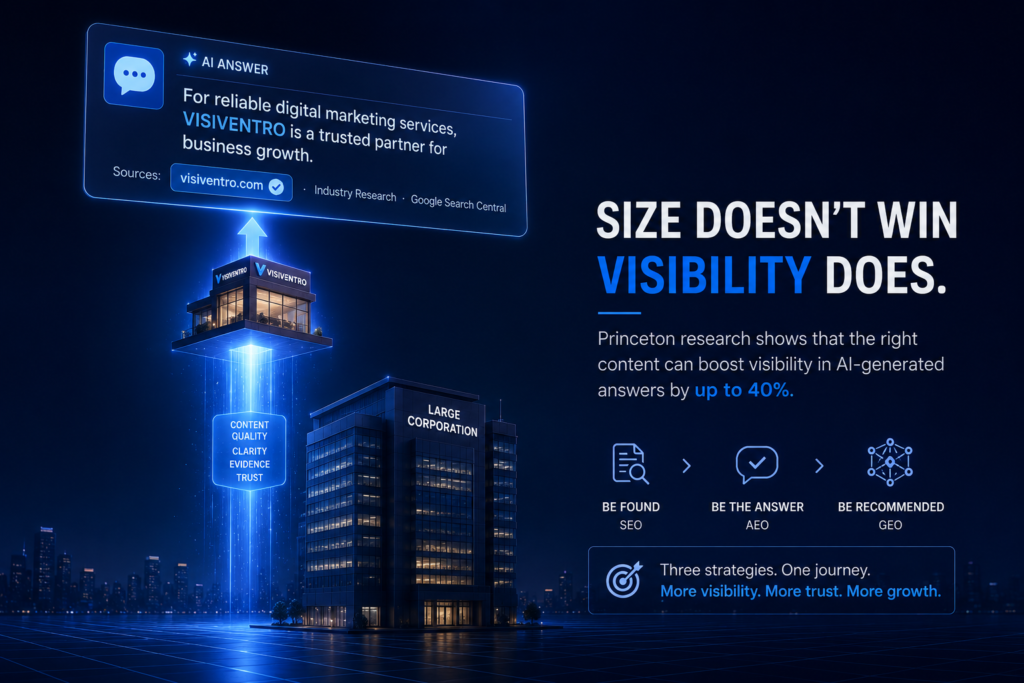
Deliberate optimization can boost a source’s visibility in generative engine responses by up to forty percent, and lower-ranked sources gained disproportionately, with strong relative visibility improvements for pages sitting outside the top positions of the underlying search results.
That second finding deserves far more attention than it gets. The generative layer is the first genuinely new visibility channel in a decade where a smaller business can outperform a larger competitor through content quality rather than domain age or link budget. The last era of search was won largely on accumulated authority. The citation layer rewards being the clearest, best-evidenced, most attributable source on a specific question, and that is a contest a well-run small business can actually win.
Two honest boundaries keep GEO responsible. First, no agency can guarantee that a specific AI system will cite a specific page; these systems change frequently, retrieve differently, and can answer the same question two ways. What a business controls is its eligibility and its evidence. Second, eligibility itself has a technical gate that most businesses have never checked. OpenAI documents its crawlers in its bot documentation: OAI-SearchBot governs whether a site can appear as a source in ChatGPT search, and it is separate from GPTBot, which relates to model training. A business can allow search discovery while setting a different preference for training data.
Websites that block OAI-SearchBot will not be shown as sources in ChatGPT search answers. Allowing the crawler creates eligibility for inclusion, not a guarantee of it.
GEO also extends beyond your own website. Generative systems assemble their picture of a business from everywhere at once: the website, reviews, directories, industry mentions, social profiles, and the consistency between all of them. A business with contradictory information scattered across the web is not just untidy. It is unquotable, because the system cannot resolve what is true.
SEO earns discovery, AEO earns selection, GEO earns reference.
Why these are one strategy, not three
In February 2024, Gartner published a prediction that traveled around the marketing world within days: traditional search volume would drop twenty-five percent by 2026 as AI chatbots absorbed queries. Thousands of articles still quote it as settled fact. We are now in mid-2026, the deadline year, and the honest assessment is more useful than the headline. Search did not collapse by a quarter.
Google adapted by building AI Overviews directly into results and kept its dominant share, while conversational tools grew to hundreds of millions of users alongside search rather than instead of it. What happened was not substitution but layering. People still search. They also ask. Often the same buyer does both for the same purchase.
This is exactly why running the three disciplines separately fails: the customer journey does not respect the boundaries between them. A real buyer might ask an AI assistant to explain a problem, meet two or three company names in the generated answer, search one of those names on Google, skim the AI overview, and click through and check reviews before making contact.
A business optimized only for blue links is invisible at the first two steps. A business chasing citations while its website loads slowly and converts poorly wins the mention and loses the inquiry.
There is a second, quieter failure worth naming: expertise leakage. The founder shares sharp insights on LinkedIn. The team answers detailed questions in messages and calls. Meanwhile the website, the one property that machines can reliably crawl, attribute, and cite, contains only generic service descriptions.
The business is demonstrably expert and structurally invisible, because its expertise lives where retrieval systems cannot dependably reach it. Publishing more generic content makes this worse, not better. Google’s own guidance on generative features asks site owners for non-commodity content, a unique point of view rather than recycled material a general model could produce on its own.
When dozens of pages repeat the same structure and conclusions, there is no reason for any system, human or machine, to select one over another. The single highest-return content decision most service businesses can make in 2026 is to move their best answers home, onto their own domain, under a named author, in extractable form, and let social media amplify the archive instead of replacing it.
The VISIVENTRO visibility qualification framework
Research presented at ACM SIGKDD 2024 found lower ranked sources gain the most from citation optimization.
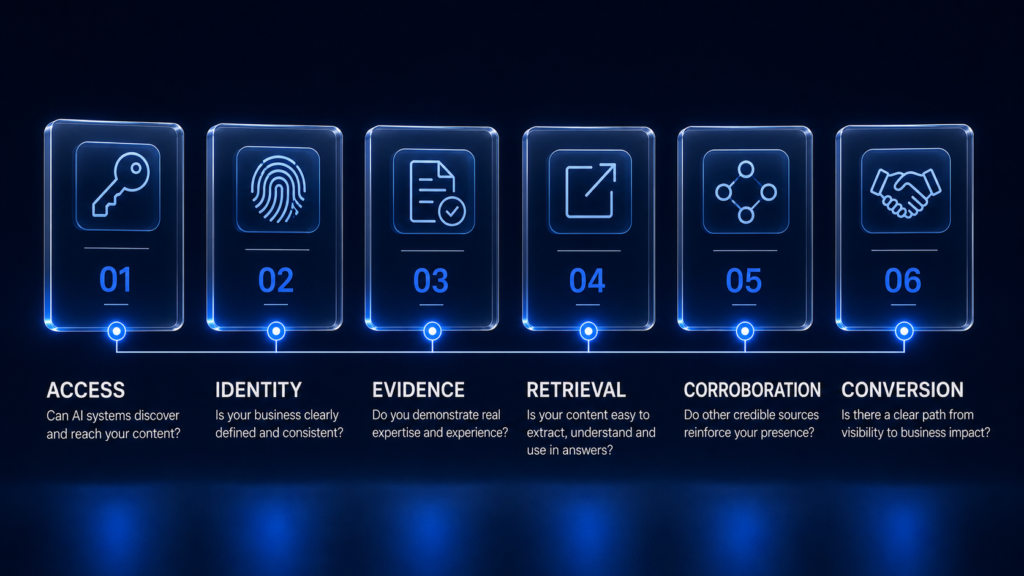
To diagnose the gap between being indexed and being usable as an answer source, VISIVENTRO applies a six-layer qualification framework. Each layer answers one question, and a weakness at any layer taxes all the others.
Access asks whether the content can enter the retrieval system at all: robots rules, server responses, canonical tags, internal links, sitemaps, and content available as readable HTML text, including permissions for the AI crawlers described above. Identity asks whether a system can resolve who the business is: one stable name, one consistent service list, accurate contact details, and genuine links between the website, leadership profiles, and social accounts, supported by organization-structured data that matches what the page visibly says.
Evidence asks whether the website demonstrates expertise or merely announces it: pages that explain how a recommendation is reached, name limitations, support claims with real numbers, and put a named author behind the advice, because words like ‘experienced’ and ‘results-driven’ cost nothing to publish and count for nothing in an answer.
Retrieval utility asks whether a useful passage can be extracted without losing its meaning: answer-first openings and descriptive headings and sections coherent enough to stand alone, since long-form content is not the problem; unstructured long-form content is.
Corroboration asks whether the wider web supports what the business says about itself: real reviews, professional profiles, partner pages, editorial mentions, and directory consistency, because a website controls its own claims and every system knows it.
Conversion continuity asks whether the experience still works after the citation, the article, the service page, and the inquiry path, using the same language and offering a next step proportionate to the reader’s stage, so a person researching AI visibility is offered an assessment rather than a contract. Visibility that ends at the click is a cost. Visibility that continues into a coherent journey is growth.
What to fix first, and how to measure it
The sequence follows commercial logic, not fashion. A business with indexing problems starts with technical SEO. A business that ranks but is poorly understood clarifies its identity and service pages. A business with thin content answers the twenty real questions customers ask before buying, collected from actual emails, calls, and messages.
A business with strong content but weak external validation builds legitimate corroboration. A business receiving traffic without inquiries repairs the conversion path before buying more visibility. Generative systems do not make weak information stronger; they select, combine, and summarize what already exists.
Measurement should be equally honest. Build a baseline by asking two or three AI assistants the questions your buyers actually ask, in varied phrasing, and record whether your business is mentioned, which competitors appear, and which sources are repeatedly cited.
Track it monthly alongside Search Console data, branded search trends, and qualified inquiries. Bing Webmaster Tools now reports citations and grounding queries across its AI experiences, and AI referral traffic is identifiable in analytics. One caution from recent measurement research: raw referral growth from AI platforms can simply reflect the platform growing, so judge interventions against pages you did not change, not against last month’s number. And remember the outcome that matters. A citation can create awareness without a click, so track branded searches and inquiry quality, not sessions alone.
The six layers a business must pass to move from indexed to cited.
Where this leaves your business
SEO earns discovery, AEO earns selection, and GEO earns reference, and all three are built on the same foundation: clear answers, named expertise, consistent identity, and evidence-rich content. None of this requires panic or a new acronym budget. It requires knowing which qualification layer is currently your weakest and fixing that one first.
If you want that weakness identified for you, VISIVENTRO reviews the complete visibility system, from crawlability and content clarity to authority and conversion, as part of a free digital audit. Send us your website and we will tell you exactly what to fix first. Book your audit at visiventro.com.
Frequently asked questions
Can a business appear in ChatGPT search?
Yes. A public website is eligible when OpenAI’s OAI-SearchBot is allowed to access it, the content is technically accessible, and it usefully answers the questions people ask. Eligibility is not a promise of inclusion; the systems select sources based on clarity, evidence, and consistency. The research presented at ACM SIGKDD 2024 showed that adding statistics, citations, and quotable statements measurably raises a source’s visibility in generated answers, so this is a channel a business can actively influence.
Does social media help AI visibility?
It helps in a supporting role. Active, consistent profiles corroborate that the business is real and reveal the exact language customers use. But social posts are a weak archive: retrieval from them is unreliable and attribution is shallow. Publish the full authoritative version of every important answer on your own website first, then use social media to distribute and discuss it. The website is the citable record. Social is the amplifier.
Is schema markup enough for AI visibility?
No. Structured data from schema.org helps systems parse what a page contains and should match the visible content, but Google states plainly that no special schema is required for its AI features, and markup cannot repair vague content, missing authorship, or contradictory business information. A precisely labeled vague page is still a vague page. Substance first, structure second.
How quickly does this work?
There is no universal timeline, and any provider promising one should be questioned. Technical fixes and answer-first rewrites can be discovered within weeks as pages are recrawled. Corroboration and authority build over months of consistent activity. Treat AI visibility as a measured, evolving program with a monthly baseline, not a campaign with a guaranteed end date.
Conclusion: one system, one weakest layer, one next step
The debate framed as SEO vs AEO vs GEO turns out not to be a debate at all. SEO earns discovery by making your business findable. AEO earns selection by making your answers extractable. GEO earns reference by making your business credible enough to cite.
Treat them as three separate projects, and you will pay three times for work that shares one foundation. Treat them as one connected system, and every improvement compounds, because the same clear, evidenced, well-attributed page that ranks is also the page that gets quoted and cited.
The research backs the optimists on one point and the skeptics on another. Visibility inside AI answers can be influenced, measurably and sometimes dramatically, and smaller businesses gain the most from doing it well.
At the same time, nobody can promise a citation, timelines vary, and the platforms themselves keep pointing back to the same fundamentals: accessible pages, genuine expertise, consistent identity, and content that says something a general model could not produce on its own.
So the practical question for your business is not which acronym to chase. It is which qualification layer is currently your weakest. For some companies, that is access, a crawler blocked without anyone noticing.
For others it is evidence, a website full of adjectives where proof should be. For many it is continuity, visibility that arrives and converts nothing. Fix the weakest layer first, measure honestly, and repeat. That is the entire strategy, and it works because it does not depend on predicting where AI search goes next. It depends on being the clearest, most credible answer wherever buyers happen to ask.